
Custom Multi-Location & Franchise Management Software: Control Every Branch From One Place

Opening the second location feels like a win. Opening the fifth already feels like losing control. Every new store brings its own spreadsheet, its own WhatsApp group for reporting the daily cash count, and its own version of “how we do things here.” By the time a company reaches ten locations — or signs its first franchisee — the owner can no longer say with confidence what yesterday’s total sales were, which branch is sitting on excess stock, and which one is about to run out of product.
Custom multi-location management software exists to solve exactly that problem: giving leadership centralized visibility and control without stripping away the day-to-day autonomy each branch needs to operate.
The signs that growth has outpaced control
The problem rarely shows up with the second location. It shows up once several of these signs pile up at once:
- Manual, delayed reporting. Branch managers text daily sales over WhatsApp or email a spreadsheet, and leadership only learns about a bad day a week later.
- Uncoordinated inventory. One branch is overstocked on a product while another is placing an urgent order with a different supplier, unaware the same item already sits thirty minutes away.
- Inconsistent pricing and promotions. Each location applies discounts at its own discretion because there’s no central system enforcing rules automatically.
- Zero comparative visibility. There’s no simple way to see which branch is most profitable, which one needs support, or which model is worth replicating.
- Franchisees operating blind. If the business already sells franchises, each franchisee reports however they can, and the brand has no reliable way to audit whether operating standards are actually being followed.
None of these signs sink a business overnight. But each one quietly eats into margin, and together they explain why chains that should get more profitable with scale often end up operating worse than they did with a single location.
Why generic tools fall short
Off-the-shelf point-of-sale systems tend to handle a single location well. The trouble starts when you need to add them up: they rarely offer a real corporate-level dashboard, almost never support tiered permissions (corporate, regional, branch), and hardly any of them model franchising well, where the brand owner needs visibility into data the franchisee doesn’t always want to share in full.
The result is companies exporting reports from each branch by hand and consolidating them into a master spreadsheet someone builds at the end of every month — with numbers that already arrive too late to act on.

What a custom multi-location system needs to solve
Real-time operation at every branch
Each point of sale needs to record sales, cash counts, and inventory quickly, without depending on a constant connection to headquarters. Syncing should happen in the background, never blocking the day-to-day operation.
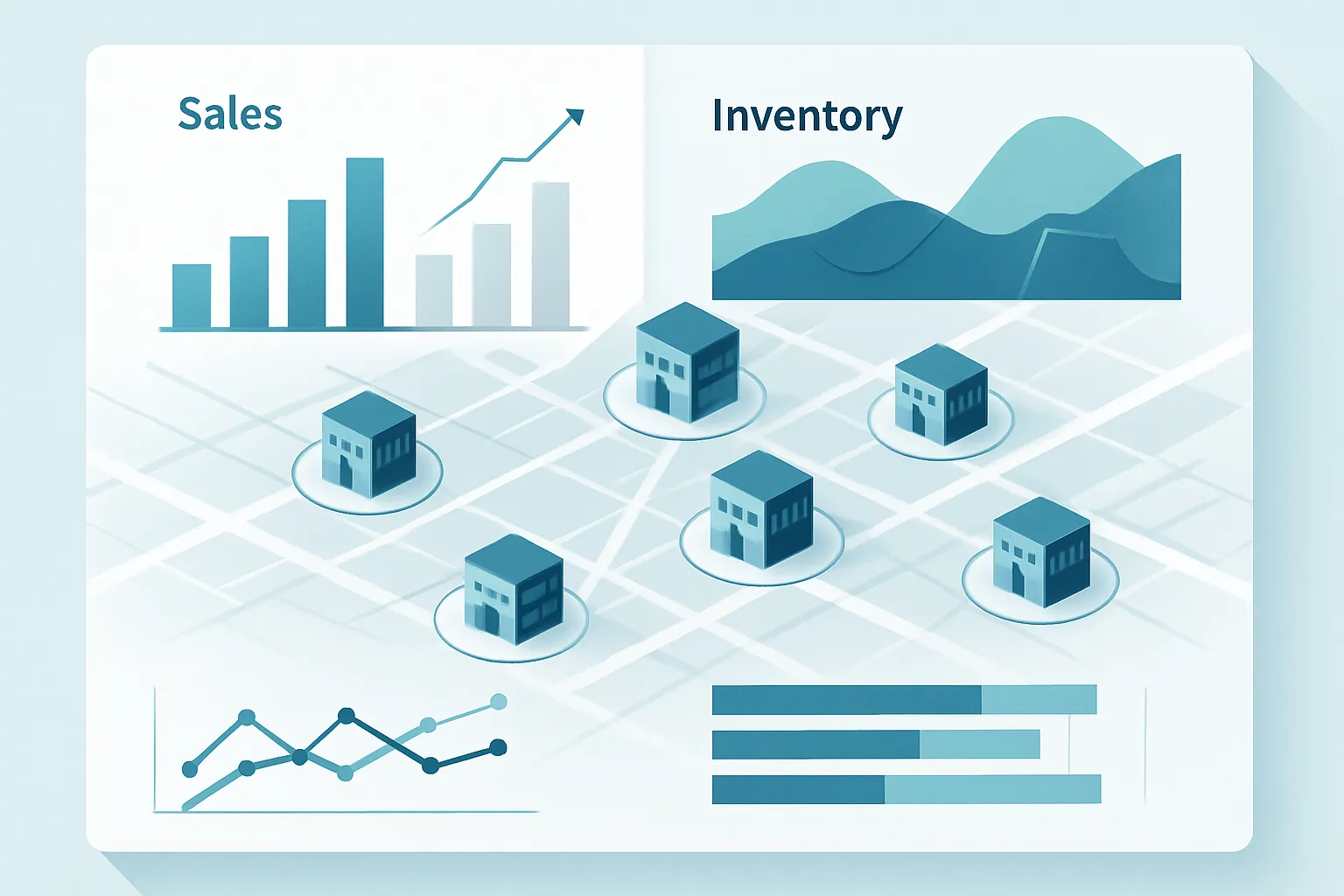
A consolidated corporate dashboard
Leadership needs to see, in one place, in real time:
- Sales comparisons across branches, regions, and time periods.
- Consolidated inventory, with alerts flagging when it’s smarter to transfer stock between branches instead of ordering more.
- Goal attainment by branch, manager, or franchisee.
Tiered roles and permissions
Not everyone should see everything. A well-designed system separates what a branch manager sees from what a regional supervisor and the executive team see — and, for franchises, precisely defines what data the franchisee shares with the brand and what stays inside their own operation.
Standards enforced automatically
Pricing, promotions, recipes, or operating procedures get configured once at the corporate level and apply across every location, eliminating the branch-by-branch variation that erodes both margin and brand experience.
The particular case of franchises
Once a business sells franchises, the software stops being just an operational tool — it becomes the mechanism the brand uses to audit that its standards are actually being followed without visiting every location in person. Compliance reports, alerts on pricing or process deviations, and performance comparisons across franchisees turn the system into the backbone of brand control — something no mature franchise can sustain on trust and occasional site visits alone.
Benefits that show up on the P&L
- Faster decisions, because data arrives the same day instead of the following week.
- Less capital tied up in inventory, by transferring stock between branches instead of over-ordering.
- A more consistent brand experience, because pricing and promotions match across every location.
- Safer expansion, because opening branch number fifteen no longer means losing visibility into the first fourteen.
How to get started
There’s no need to digitize fifty locations in month one. What works is starting with whatever report causes the most headaches today — usually the daily sales close or inter-branch inventory control — and building a system from there that grows alongside the chain.
At Kimo Solutions we design custom multi-location and franchise management systems around the way your business actually operates, not the other way around. If your company has already outgrown your ability to keep track of every branch, let’s talk about your operation.
Have a project in mind?
Get in touch →